
Fullness and Emptiness
From Bodily Activation to the Power to Act

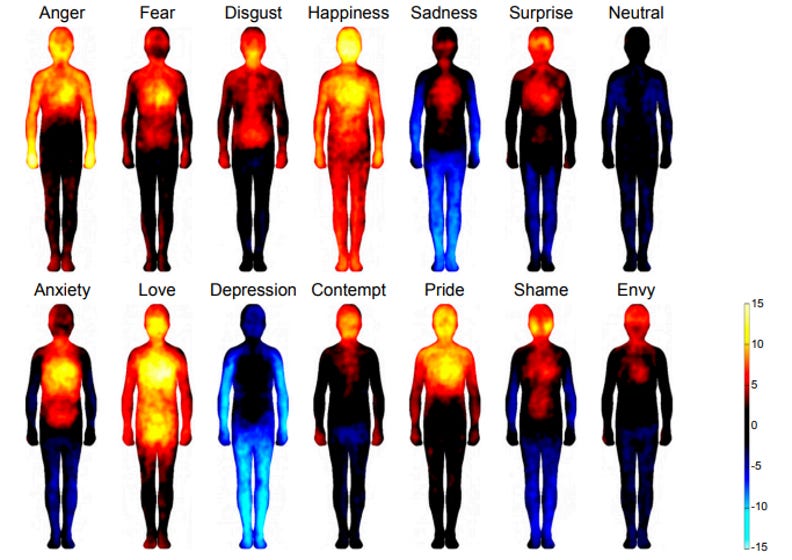
In the bodily sensation maps associated with emotions obtained in the study by Nummenmaa and colleagues (2014), happiness appears as an increase in perceived activity across the entire body.
This image resonates with Antonio Damasio’s idea that states of happiness correspond to a condition in which the body is experienced as a harmonious whole, correlated with a state of homeostasis (Damasio, 1994) — a condition compatible with the organism’s optimal functioning .
In contrast, negative (unpleasant) emotions often involve a body that fragments into zones of unequal intensity — a tightness here, tension there, weakness, a sensation of cold in one part and warmth in another.
This pattern can be interpreted as compatible with allostatic processes, in which the organism makes predictive adjustments of its resources in response to specific demands, often mobilizing particular regions of the body.
Therefore, happiness seems to involve a more globally distributed pattern of activity across the body, whereas negative states often involve more localized or uneven patterns.
This difference in bodily distribution may also be related to how open or restricted the organism’s field of possible actions becomes.
**
Broaden-and-Build Theory
In line with this, the Broaden-and-Build Theory, developed by Barbara Fredrickson, proposes that positive emotions expand the repertoire of thoughts and actions available to the organism, whereas negative emotions tend to narrow it.
As Tugade and Fredrickson (2004) write:
“This theory posits that negative emotions narrow one’s momentary thought–action repertoire by preparing one to behave in a specific way (e.g., attack when angry, escape when afraid). In contrast, various discrete positive emotions (e.g., joy, contentment, interest) broaden one’s thought–action repertoire, expanding the range of cognitions and behaviors that come to mind.”
Thus, we can relate this proposal to the bodily maps mentioned above. Since happiness tends to display a more globally distributed pattern of perceived bodily activity, this may be reflected in a broader range of possible thoughts and actions, as the individual is not constrained by specific bodily sensations that would lead to more narrowly defined responses.
By contrast, negative emotions often show more pronounced differences between areas of activity, with some regions exhibiting greater activation than others. This pattern may correspond to a restriction in the range of thoughts and actions that emerge in response to specific stimuli.
In this sense, the psychological idea that positive emotions broaden the field of possible actions appears strikingly close to a much older philosophical insight.
**
A Parallel in Spinoza
A comparable framework already appears in the philosophy of Baruch Spinoza.
In Ethics (1677/2000), Spinoza defines joy (laetitia) and sadness (tristitia) as transitions involving, respectively, an increase or a decrease in the body’s power to act (corporis potentia agendi).
Among the species of joy, pleasure (titillatio) affects one part of the body more than the others, whereas cheerfulness (hilaritas) consists of a more evenly distributed increase of power across the whole body.
Conversely, pain (dolor) and melancholy (melancholia) are species of sadness, the former affecting a part of the body disproportionately, and the latter involving a more global diminution of the body’s power.
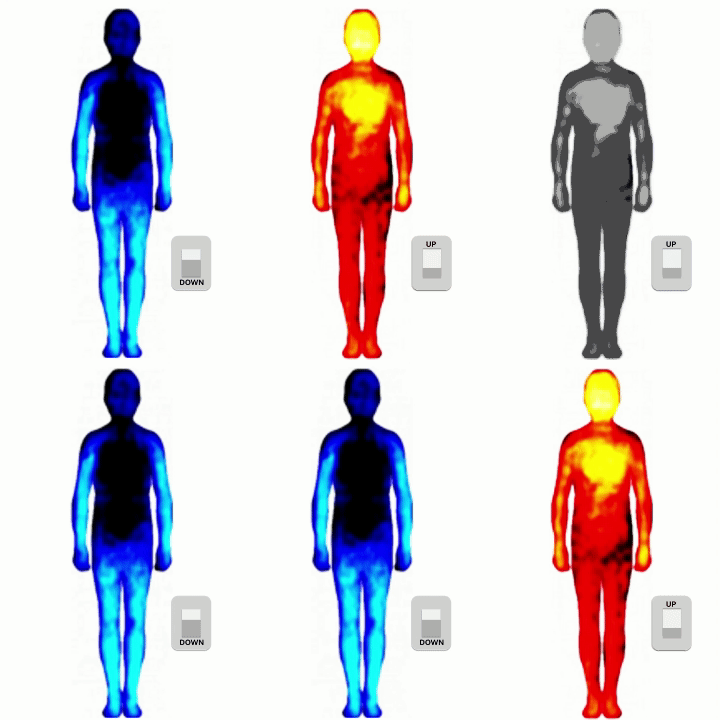
When viewed from this perspective, the bodily pattern associated with happiness in the maps of Nummenmaa and colleagues resembles what Spinoza calls cheerfulness, whereas the pattern associated with depression resembles melancholy.
In these states, there does not appear to be a concentration of “energy” in any particular area of the body; rather, the increase or decrease in vitality seems to be more evenly distributed throughout the body.
Description
Fullness
In my own experience, states of happiness that resemble what might be called fullness are felt as if bodily “energy” were flowing through the entire body without obstruction, giving rise to a sense of the body as a harmonious whole, as described by Antonio Damasio (1994) cited earlier. There is a diffuse sense of vitality.
In such states, I often have the impression that I could do anything and, at the same time, that I do not need to do anything. In my case, the flow of thoughts also tends to decrease, perhaps because there is no immediate problem or disturbance that requires resolution. Instead, there is a sense of satisfaction, as if things were already in place and nothing demanded correction or completion.
Free to experience this sense of well-being and completeness, the mind seems to expand in the sense of being open to possibilities without being tied to anything specific, allowing one to see the world more clearly — yet without this corresponding to a noisy or crowded mind.
This condition seems compatible with the idea that positive emotions broaden the space of possible actions. Because the organism is not mobilized toward a specific defensive or corrective response, many possibilities remain open.
—
Depression
In contrast, in depression I experience various negative emotions, such as sadness, anguish, and irritation, together with a sense of emptiness.
There is also a marked decrease in bodily vitality and a pervasive lack of “energy”, accompanied by a deep discouragement and an almost complete lack of motivation to engage in any activity, even those that previously brought me some pleasure.
In such moments, even thinking seems to lose its momentum: it is not that there are no problems to think about — the depression itself is a problem — but rather that thought no longer seems to know where to go or what to do, as if it lacked the force to unfold.
**
Conclusion
The central idea is to contrast experiences of fullness and emptiness: happiness, when experienced as fullness, involves a globally distributed increase in bodily activity that gives rise to a sense of bodily harmony, whereas depression involves a generalized decrease in vitality, which may correspond to states of emptiness.
Other emotions, whether positive or negative, tend to involve more localized or uneven patterns of activation.
These different bodily configurations may correspond to a greater or lesser openness of the field of thought and action, echoing what Spinoza described as an increase or decrease in the body’s power to act.
**
Notes
Depression should not be understood simply as an emotion. It is better described as a complex disorder that may involve a weakening of bodily vitality and motivational energy, together with a constellation of negative emotional states, as I have described above.
The contrast drawn here between fullness and depression (emptiness) is therefore based only on the labels used by Nummenmaa and colleagues for the emotional states represented in their bodily maps, and is intended merely to highlight two opposite poles in the way bodily vitality can be experienced.
**
Reference
Nummenmaa, L., Glerean, E., Hari, R., & Hietanen, J. K. (2014). Bodily maps of emotions. Proceedings of the National Academy of Sciences of the United States of America, 111(2), 646–651. https://doi.org/10.1073/pnas.1321664111
Damasio, Antonio R. (1994). Descartes’ Error: Emotion, Reason, and the Human Brain. New York: G.P. Putnam.
Tugade, M. M., & Fredrickson, B. L. (2004). Resilient individuals use positive emotions to bounce back from negative emotional experiences. Journal of personality and social psychology, 86(2), 320–333. https://doi.org/10.1037/0022-3514.86.2.320
Spinoza, B. (2000). Ethics. London: Penguin Classics.
Nice, I really like this type of content from you
One of the most satisfying contents that I read nowadays. Thanks for that