
Emotional Regulation
Modulating Emotions

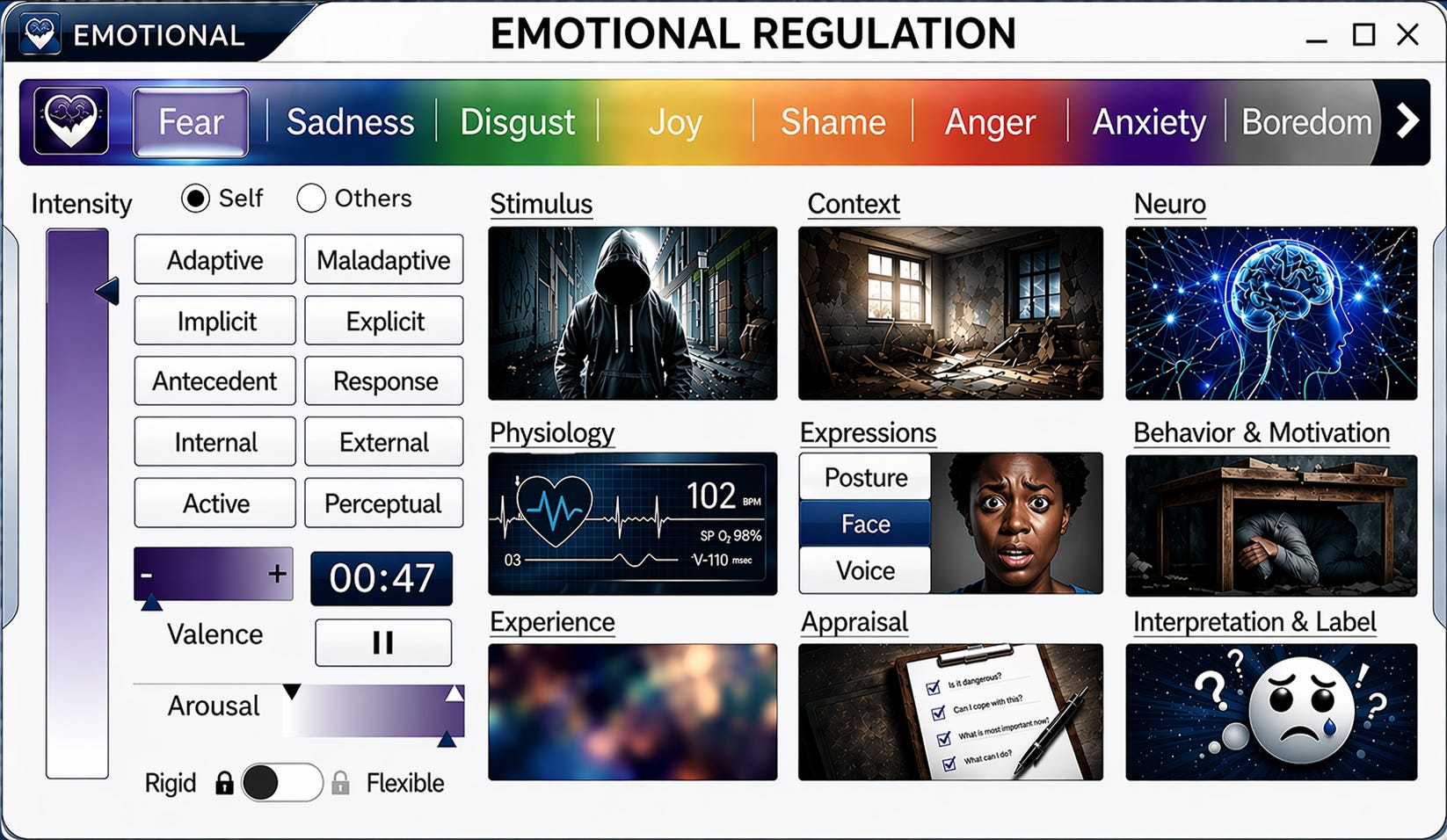
-When an emotion arises, but you prefer not to express it or act on its impulse, how do you deal with that?
-How do you hold back your impulse or expression—if that’s the case—for example, when you’re angry but choose not to act on the urge to physically or verbally hurt someone, or to destroy an object?
-How do you calm yourself in a situation where anxiety prevents you from acting the way you think you should?
**
This is an introductory article in which I present an overview of the different types and strategies of emotional regulation. In future texts, I intend to explore them in greater detail from a phenomenological perspective.
**
Introduction
Emotions are fundamental to our survival, but they do not always work in our favor. When they arise with excessive intensity, persist longer than necessary, or are not congruent with the situation, they can significantly impair our day-to-day functioning.
Thus, the ability to regulate our emotions becomes a crucial aspect of our well-being and helps prevent us from being completely dominated by them.
Emotional regulation can be understood as the set of processes through which we influence which emotions we feel, when we feel them, and how we experience and express them.
Through it, we can employ strategies to facilitate the emergence of an emotion, inhibit its expression, maintain and prolong its experience, increase or decrease its intensity, and even transform the quality of what we are feeling.
When this regulation fails—whether due to excess, rigidity, or a mismatch with the context—emotions can become disproportionate, persistent, or disconnected from reality.
In this context, emotional dysregulation emerges as a central factor in various psychopathologies, such as depression, anxiety disorders, and phobias, in which dysfunctional emotional patterns tend to persist and reinforce themselves. (Pop-Jordanova, 2023)
**
Axes of Emotional Regulation
When we take a closer look at how we regulate our emotions, it is possible to identify different dimensions or “axes” along which these strategies vary:
Adaptive vs. Maladaptive
Adaptive strategies are those that, in the medium and long term, contribute to well-being and to the resolution of situations, such as cognitive reappraisal or acceptance. In contrast, maladaptive strategies, such as avoidance, may provide immediate relief but tend to maintain or intensify the problem over time.
However, the same strategy can be maladaptive in one context and still be adaptive in another.
For example, avoiding social situations due to fear of judgment can lead to missed opportunities for growth and contribute to the worsening of social anxiety, which tends to intensify the more such situations are avoided.
On the other hand, avoiding situations that involve real risk to one’s life may be not only appropriate, but the best strategy to adopt in those circumstances.
—
Implicit vs. Explicit (Braunstein, Gross & Ochsner, 2017)
Another relevant distinction is between implicit and explicit regulation. Implicit regulation occurs automatically, without conscious effort—such as when we naturally distract ourselves from something unpleasant—whereas explicit regulation involves deliberate effort, such as deciding to reinterpret a situation or to control one’s emotional expression.
For Examples:
Implicit: When we turn on the TV, computer, or phone to watch a film on a streaming platform, we often don’t realize that we are trying to escape a state of boredom or seeking out an emotion—one that may even be considered unpleasant in many contexts, such as fear when choosing a horror film or sadness when opting for a drama.
Explicit: On the other hand, when I am very tense or anxious before a presentation—to the point that it interferes with my concentration on my speech—I can deliberately try to calm myself.
To do so, I may turn to breathing or relaxation techniques, use self-affirmations that I already know everything I need to say and that everything will go well, or draw on any other strategies I am familiar with.
—
Antecedent-Focused vs. Response-Focused (Gross, 1998)
We can also distinguish between antecedent-focused and response-focused strategies.
Antecedent-focused: these operate before the emotion is fully established, for example by avoiding a potentially stressful situation or reinterpreting it from the outset.
Response-focused: these come into play once the emotion is already underway, aiming to modulate it after its activation, such as trying to calm oneself during an episode of anger or anxiety.
—
Internal Resources vs. External Resources
In another dimension, we can distinguish between strategies that rely primarily on internal resources—such as attention, reflection, imagination, memory, and the regulation of breathing—and those that draw on external resources, such as seeking social support, modifying the environment, or using objects and substances.
—
Active Inference vs. Perceptual Inference (Farb, 2015)
A particularly interesting distinction is between regulation through active inference and perceptual inference.
Active inference involves acting to make the world (or the body) better match prior expectations, whereas perceptual inference involves updating perception to make sense of incoming signals.
In active inference, the individual regulates emotion by acting on the environment or the body—for example, leaving a stressful situation or engaging in physical activity to reduce tension.
In perceptual inference, the emphasis shifts toward allowing the emotion to unfold while refining how it is perceived, rather than directly trying to change it.
Paradoxically, this can transform the experience through an expanded awareness of it. Mindfulness practices are one way of cultivating this mode.
However, perceptual inference is not entirely passive; it can operate in a more open mode, sustaining uncertainty rather than rapidly converging on a single interpretation, thereby creating space for multiple hypotheses about bodily signals to emerge.
This relative downregulation of action supports insights into bodily states and available internal resources, as it allows experience to reorganize before being “closed off” by an immediate response.
—
It is also worth noting that these strategies can be mobilized not only to regulate our own emotions (intrinsic), but also to influence the emotions of others (extrinsic). (Nozaki & Mikolajczak, 2020)
—
Finally, individuals may vary in how rigid or flexible they are in using these strategies.
Flexibility refers to the ability to adapt and switch strategies according to the context; more flexible individuals adjust their regulation in response to situational demands.
Rigidity is characterized by the repetitive use of the same strategy across different contexts, which tends to be less effective and more closely associated with distress.
**
Interventions in Emotional Components
Beyond these “axes,” emotion regulation strategies can also be understood in terms of interventions carried out on the different components of emotion presented here.
We can intervene directly on the stimulus, modifying what triggers the emotion. It is also possible to act on the context—for example, by gradually exposing ourselves to an aversive stimulus in safe environments, which facilitates desensitization processes.
There are also interventions at the neurophysiological level, such as the use of substances that alter brain activity. At the physiological level, techniques such as breath control, relaxation, and physical exercise make it possible to directly modulate the bodily state associated with emotion.
Regulation can also occur through emotional expression: by modifying posture or facial expressions, this can influence not only how the emotion is communicated, but also the internal experience itself.
Motivationally, emotion regulation can occur through the mobilization of goals, as well as the inhibition or redirection of action impulses, thereby avoiding automatic responses driven by the emotional state.
At the behavioral level, we can avoid, withdraw from, or approach certain stimuli to reduce unpleasant emotions or intensify pleasant ones. In situations of anxiety, for example, I may pace back and forth as a way of trying to modulate my emotional state.
In terms of subjective experience, I can simply observe the sensations and impulses that arise, without trying to modify them or act on the tendencies they evoke—remaining only as a silent witness to what is unfolding in my body and mind.
From a cognitive standpoint, strategies include cognitive reappraisal, in which I try to evaluate the situation from other perspectives; as well as approaches such as the use of positive self-affirmations, distraction, the construction of meaning around the emotion and the situation, and even labeling what one feels, which can make the experience clearer and more manageable.
Therefore, emotional regulation does not constitute a single process, but a dynamic set of possibilities that span the body, mind, and environment. Within a single emotional episode, we can draw on different strategies—individually or in combination—in search of the one that best deals with what we are feeling.
Understanding these different dimensions not only broadens our theoretical understanding of emotions, but also opens up space for a more conscious and flexible relationship with what we feel.
**
As I also explored in another article linked below, emotions interact with one another, mutually regulating each other.
**
References
Pop-Jordanova N. (2023). Emotional Dysregulation is the Core Problem in Psychopathological Manifestations. Prilozi (Makedonska akademija na naukite i umetnostite. Oddelenie za medicinski nauki), 44(2), 7–16. https://doi.org/10.2478/prilozi-2023-0020
Gross J. J. (1998). Antecedent- and response-focused emotion regulation: divergent consequences for experience, expression, and physiology. Journal of personality and social psychology, 74(1), 224–237. https://doi.org/10.1037//0022-3514.74.1.224
Braunstein, L. M., Gross, J. J., & Ochsner, K. N. (2017). Explicit and implicit emotion regulation: a multi-level framework. Social cognitive and affective neuroscience, 12(10), 1545–1557. https://doi.org/10.1093/scan/nsx096
Farb, N., Daubenmier, J., Price, C. J., Gard, T., Kerr, C., Dunn, B. D., Klein, A. C., Paulus, M. P., & Mehling, W. E. (2015). Interoception, contemplative practice, and health. Frontiers in psychology, 6, 763. https://doi.org/10.3389/fpsyg.2015.00763
Nozaki, Y., & Mikolajczak, M. (2020). Extrinsic emotion regulation. Emotion (Washington, D.C.), 20(1), 10–15. https://doi.org/10.1037/emo0000636
It has taken me many years of practice to regulate my emotions.
This week during a Google office meeting, I was highly triggered when my coworkers decided to re-create my Monday morning workflow without a conversation with me first.
When they asked for my input, I paused and explained I needed a minute because I was feeling extremely triggered, and I needed to think about what they were saying. After a few minutes of composure, I articulately made three points to explain why this was not appropriate and not a good idea.
Stop, pause, think. So much better than the way I used to be very reactive and started yelling.
I write about my emotions a lot and how I have learned to manage them. Writing is the main way I manage my emotions. It has always been my go to tool. About 15 years ago I discovered yoga and meditation.
You are a pro and I will probably order your book. If it is the click of a few buttons, I am in.
A thoughtful and insightful piece, your exploration of emotional regulation really deepens the way we understand and relate to our feelings. Thank you for sharing this perspective.