
Creativity
The Process


Creativity is the capacity to generate new ideas, and this also includes the capacity to express in an original way ideas that are already established, connecting knowledge, perceptions, experiences, and affects, exploring new perspectives, and finding singular forms of expression.
Creative ideas manifest themselves both in useful inventions and technical innovations that solve problems and transform circumstances, and in philosophical and artistic formulations that produce reflections and shifts of meaning, express feelings, evoke emotions, and give rise to sensitive experiences: a well-constructed argument, a sentence that precisely captures an affect, a story that inspires, a poem that moves, a painting that reorganizes the gaze, a melody that transforms the state of the one who listens to it.
Creativity, however, is not intrinsically beneficial. Inventions and innovations may serve restricted interests and contribute to the deterioration of collective life. Philosophical and artistic ideas may also be placed in the service of authoritarian projects.
In this blog, however, what matters is not so much the objective value of the idea, whether it is good, absolutely original, or socially relevant, but rather the experience of the creative process itself: the way something takes shape, becomes articulated, and gains consistency in the lived experience of the one who creates.
Moreover, although technique is essential for giving form to what one wishes to create, the creative act exceeds it. It involves elements that precede, accompany, and even surpass its execution.
**
Stages Involved in the Creative Process
Before the Idea
Everything begins before the idea. It begins with a way of being in the world: open and attentive. Open to what emerges, to what has not yet taken definite form. Attentive to the nuances of the world and of oneself, to the subtle inflections of experience, to the questions that have not yet been asked, to the perspectives that have not yet been explored. It is this state of curiosity and wonder — what philosophy calls thauma — that prepares the ground from which something new may arise.
When, for example, no specific problem presses me or calls for creation, it is still possible to deliberately evoke this field of emergence. I may turn to brainstorming, experiment with unlikely combinations, relocate familiar elements into unexpected contexts, or impose constraints that challenge my habitual patterns of thinking. Paradoxically, certain limits do not block creativity, they stimulate it, since attempting to go beyond limits requires creativity. These strategies function as activation devices: they create conditions for thought to shift, to momentarily loosen its organization, and, in that movement, to discover new articulations.
**
Birth of the Idea
The creative process involves a rich and diverse combination of cognition, sense and emotions process. The emergence of ideas resembles, in some ways, the phenomenon of having something ‘on the tip of the tongue’ (a topic I will address in another article) — though it differs in many others.
In that case, we rely on clues to recover a memory — “casting out bait” to bring it to the surface — whereas in the creative process, we draw upon reasoning attempts, imaginations, and perceptions, seeking to extract something new from the mind. In the end, while a memory may emerge in the first case, a new idea may arise in the second.
In the first case, the information seems to already exist, even if it’s just out of conscious reach. In the second, the sensation is different, there is a certain emptiness before the idea emerges. Still, it’s sometimes possible to sense that something new is taking shape, even before it fully comes to light.
**
Recognition
However, creativity is not limited to generating new ideas. There are other essential stages, one of which is a kind of recognition, in which we evaluate whether the idea that emerged is truly good and promising. Whether it’s worth investing time and effort into developing.
It’s as if I need to recognize certain qualities in it, such as, for example, aesthetic sense in art: a harmony, a balance, or some quality that fits perfectly with what I am trying to create.
“Is it beautiful? Or is it ugly in the way I want it to be? Is it flowing well? Does it make me feel what I want others to feel? Does it express what I really want to express?”
This is also crucial for evaluating the ideas of others. Sometimes, the person hasn’t fully mastered the technique, or the idea is in its early stages, but even so, it is possible to recognize its potential.
However, this process requires a certain openness. Highly disruptive ideas can be difficult to evaluate or invest in while they are still in their early stages.
**
Analyzing and Testing
After this recognition, I analyze and test the idea from different perspectives to check if the initial perception — that the idea is potentially good — still holds.
In theoretical articles, for example, the focus primarily falls on the strength of the arguments. I assess whether they are insightful, whether the sentences are well-constructed, coherent with the premises, and consistent with the evidence, whether they clearly and precisely convey what I wish to express, whether the reasoning is logical and cohesive, and whether it integrates harmoniously with the other elements, forming a consistent whole.
In descriptive texts, like the ones I aim to create here, I also observe these aspects, in addition to evaluating whether the way I describe the experiences conveys, with the greatest possible precision, what I perceive to occur phenomenologically.
In certain situations, the value of an argument lies not in its apparent conformity with reality, but in its persuasive strength.
In these cases, aesthetic and emotional value, as in the creation of a catchy phrase, can be decisive — and in recognizing them, the same steps described above are followed.
**
Reactions to the Emergence of an Idea
In the process of an idea’s emergence, as already mentioned, it is sometimes necessary to focus, reason, and reflect so that it can emerge, and then examine it to see if there is truly something in it that seems valuable.
Then, a sense of certainty and recognition of its value may arise — accompanied by surprise, because although I often actively search for an idea, it always emerges in an unexpected way, surprising me and then generating a sense of satisfaction that manifests as an excitement.
When the solution found was particularly difficult to achieve, it may be accompanied by a sense of pride that manifests as a kind of ‘anger happiness’ similar to the feeling that often emerges after a hard-earned accomplishment.
Sometimes, it comes with an exclamation: “That’s it!“ — like a small moment of eureka.
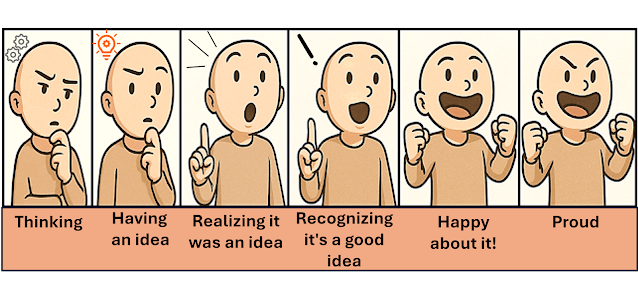
These reactions do not always follow clearly in every creative production situation. In some cases, there is more of a simultaneity between the emergence of ideas, their execution, and the recognition of their quality.
This can occur within a creative cycle, where one idea gives rise to another, and the processes of execution and recognition gradually interconnect and feed into each other.
Thus, there is not always time for each of these reactions to manifest so distinctly. This may only happen at the end of the entire process. What exists here is more like a flow where ideas and actions are connected.
**
The Unconscious Part of the Process
When I’m immersed in something — like writing a text — it seems that my mind continues to work even when I’m not deliberately focused on it and very aware of my internal work.
If I pay attention, I can even observe that I’m somehow always returning to the topic in an inner speech that occurs alongside the activities I’m doing at the moment, like, for example, taking a shower. In fact, it seems that I’m neither fully in the shower nor fully immersed in the idea.
Sometimes, something I hear or see triggers a connection with that project, or even without being in an ongoing project, without deliberately searching for a new idea, I recognize something there that, by affecting me in some way, gives birth to an idea.
Suddenly, an idea appears, and the reactions mentioned above follow. Along with it comes the fear of losing it. In these moments, I need to write it down as quickly as possible — it could be an example, an analogy, an argument, etc, something that, if I don’t capture it right away, might slip away.
A profusion of ideas may emerge, sometimes one triggering another, unfolding into several more, and if I don’t write them down, they proliferate so much that I may end up forgetting many of them.
**
Development, Refining, and Conclusion
After the recognition stage and the initial tests, the next step is the development and refinement of the idea. This is one of the moments I enjoy the most, because I’m no longer starting from scratch — there’s already something in front of me that can be worked on calmly.
I can then dedicate myself to polishing, smoothing rough edges, and combining it with other ideas. It’s a meticulous process of refinement, making it more “well-rounded.” At this stage, other ideas emerge to complement it, and with them comes the recognition of its quality for the project.
And so the idea gains depth, takes shape, until I feel that the text, the drawing, the melody, the device, or the method — whatever it may be — is ready, bringing the creative process to a satisfying conclusion. However, it can always be revisited and refined.
This feeling of conclusion also relates to various senses (aesthetic, the sense that it is complete, that everything fits together properly, etc).
Some more elaborate ideas go through this entire process; others, more immediate ones that solve pressing issues, not as much. Still, they are expressions of creativity.
**
Maturation
Often, ideas need a period of maturation. Stepping away from them and returning with a refreshed mind can help. Allowing the mind to work unconsciously, in the background, is part of the process (as mentioned above).
**
Creative Influences
In many cases, it’s possible to perceive the influences involved in the creation. For example, I’m often not fully aware of which ones I’m incorporating when creating a cartoon character (something I used to enjoy doing).
However, later on, I can recognize in the drawing traits, ways of drawing certain body parts, etc., that I drew from to create it. It’s like the “genetics” of the character.
For example, eyes resembling those of characters from The Simpsons, a line style closer to Adventure Time, and Stitch’s mouth, forming a kind of chimera, a creature composed of parts of different animals.
In the case of drawing, for me, the idea can come from many things, even from pareidolia — a psychological phenomenon in which we perceive familiar patterns, such as faces, figures, or objects, in random or ambiguous stimuli, like clouds, stains, or shadows.
As a child, I would see characters emerge from the patterns of my mother’s floral bedspread. In this case, I realize that my gaze was already imbued with a visual repertoire shaped by animated cartoons and comic books, which oriented my perception toward certain cartoon-like configurations.

Notes
Note 1: The idea to write about this topic came from a friend who had seen that I had started a blog. At the time, I told her that I was writing an article on “surprise,” but I had just lost the entire piece because, due to a error, it hadn’t been saved.
Another day, she asked me whether I had managed to finish the article about “creativity,” and I told her that, in fact, the article was about “surprise.” However, by mentioning the topic incorrectly, she ended up giving me the idea to write about creativity.
--
Note 2: Interestingly, this week, while writing about this topic, I was able to observe it happening and experience it in the very act of writing this article.
While I was taking a shower, walking, washing dishes, etc., ideas about it would come to the surface: phrases, topics, examples, etc. In this article, a profusion of ideas came to me as I was writing.
I thought: I can write about this! I can add this! I can phrase it this way, cite this example, make this analogy! I can talk about what I’m perceiving right now as the ideas for this article on creativity emerge etc.
So, I was able to confirm the stages and reactions I was describing here as they presented themselves to my awareness, in addition to noticing others.
Moreover, I was always concerned about quickly jotting down the ideas and perceptions that came to me in order to compose this article, so as not to risk losing them.
--
Note 3: Descriptions related to micro muscle activities, breathing changes, and other physiological aspects have already been covered in the articles that focus specifically on each component of creativity — such as imagery, inner speech, emotions and so on.