
Components of Emotions

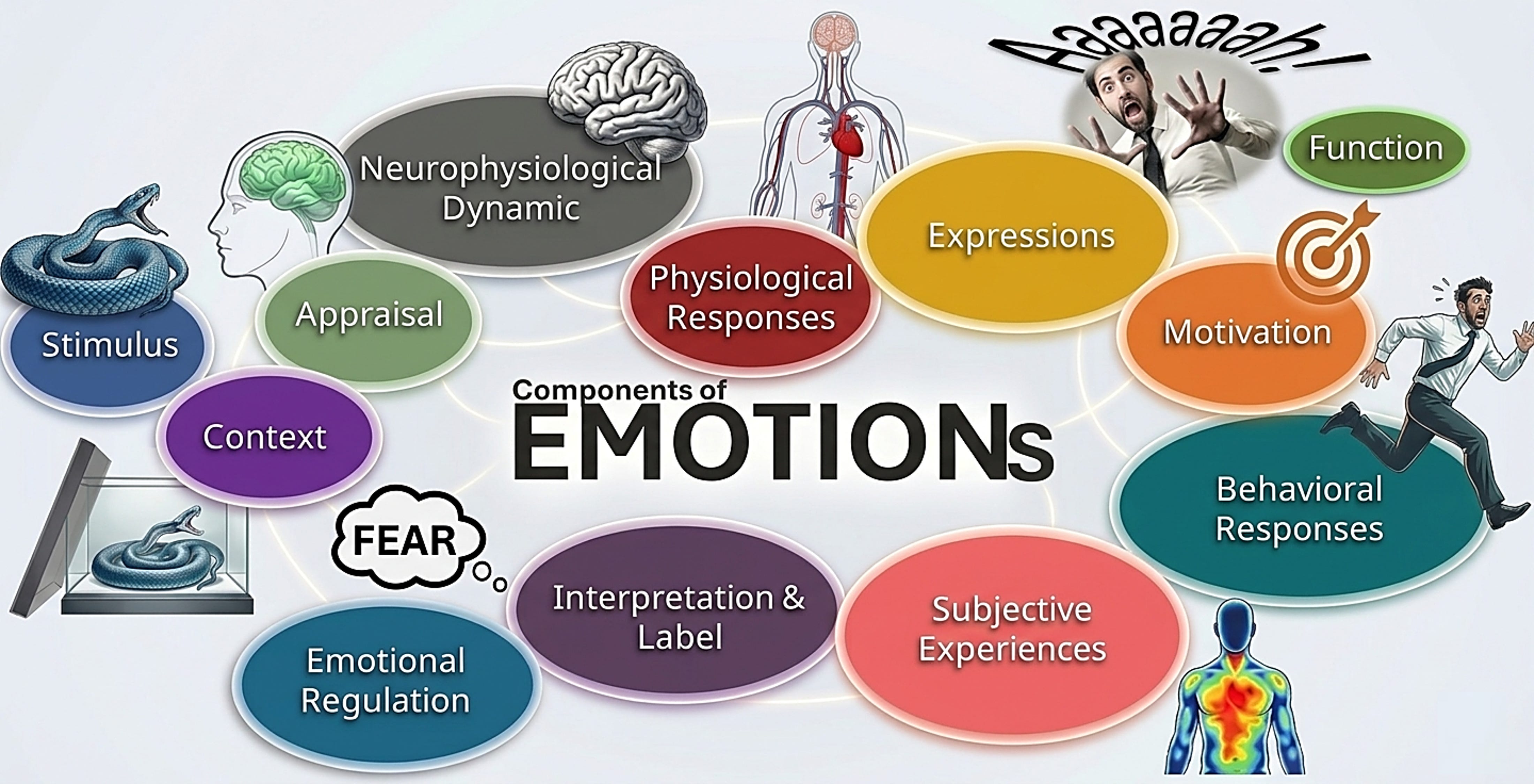
There is no consensus on the definition of emotion. Still, in general terms, it can be understood as a complex process involving multiple components. Emotion begins with the appraisal of a stimulus within a given context. This evaluation triggers distinct patterns of neural activity and physiological changes. It is expressed through bodily postures, facial expressions, and vocal modulations.
Emotions serve adaptive functions. In the case of fear, for example, its function is to avoid pain, harm, and, at a more basic level, death. The associated motivation is more specific: it arises as an impulse to protect and defend oneself, and it may be realized through behaviors such as freezing, fighting, or fleeing. Depending on the context, this response can take various forms, such as running, climbing a tree, hiding behind an obstacle, swimming rapidly, or jumping over a fence.
From the first-person perspective, this entire process is experienced as bodily sensations and action tendencies, which may later receive a cognitive interpretation and a culturally learned emotional label.
Moreover, emotion often co-emerges with attempts at regulation, in which the individual may intervene in different components of the process — by reinterpreting the stimulus, modifying the context, or inhibiting certain expressions etc — in order to modulate their own response.
In anger, for example, the adaptive function may be to impose oneself forcefully — to force one’s will — in the face of an opponent, in order to protect or conquer territory, resources, and power, to compete for a partner, to protect offspring, or to oppose an injustice, among other related goals. The motivation tends toward confrontation or attack and may manifest in different behaviors, depending on the circumstances and the social norms involved.
**
As I said in the ‘Emotions’ article:
“Each theory of emotion highlights one or more components as the most central elements of what emotions are, combining them in different ways.
For Damasio (1994), for example, physiological changes are the central component of emotion. He distinguishes between emotions and feelings, with the latter being the subjective experience of internal bodily sensations (interoception) juxtaposed with the identification of the stimulus that triggered them.
For Ekman (2003), facial expression is the primary component used to classify emotions. Barrett (2017) emphasizes the interaction between context, interoception, and concept. Adolphs and Anderson (2018) highlight functional aspects. Frijda defined emotions as states of “action readiness“(1986). Lieberman (2019) considers subjective experience as what truly defines emotion.
Other authors and researchers in the field consider different aspects and relationships. Thus, the various approaches reflect the diversity of perspectives on the fundamental aspects of emotions.”
**
Components
Stimulus
The emotionally competent stimulus (ECS — a term used by António Damásio) is that which triggers an emotional response. It may be internal — thoughts, memories, imagination, or bodily sensations — or external, that is, something present in the environment.
Some stimuli are unconditioned: they provoke emotion in a relatively universal way, without the need for prior learning. Others are conditioned: they become emotionally competent through association. They may be learned through direct experience, observation, or instruction.
Thus, potentially, anything can become an ECS.
—
Context
Context concerns where, how, and when the stimulus appears. It includes the physical and social environment, culture, the specific situation, the way the stimulus presents itself (its behavior), as well as the individual’s internal state at the moment of interaction — their physiological conditions and psychological state.
The same stimulus may generate different emotions depending on the context. A snake may provoke fear in an unexpected encounter but curiosity when observed behind glass in a terrarium. Cultural context is also decisive: what elicits shame in one culture may elicit admiration in another, and this may further depend on the specific social situation within that culture.
—
Appraisal
Even before the emotional reaction is fully established, an evaluation (appraisal) takes place: the organism assesses whether the stimulus is relevant, threatening, or beneficial.
This evaluation may be automatic and rapid, operating outside reflective awareness, or deliberate and conceptual.
—
Neurophysiological Dynamics
Emotions involve circuits in the central nervous system and the autonomic nervous system (sympathetic and parasympathetic).
Structures such as the amygdala, the insula, and the cingulate cortex are frequently associated with emotional processing. However, there are theoretical disagreements. For Jaak Panksepp, relatively specific subcortical basic emotional systems exist. In contrast, Lisa Feldman Barrett proposes that emotions emerge from distributed brain networks, without “fixed locations” for each emotion.
—
Physiological Responses
Emotions involve coordinated changes across multiple bodily systems: cardiac, respiratory, musculoskeletal, endocrine, and digestive.
There is debate about whether these responses are specific to each emotion, variable even within the same emotion category, or undifferentiated.
—
Expressions
Emotions manifest through facial, bodily, and vocal expressions.
Facial: Paul Ekman identified relatively consistent patterns associated with the so-called basic emotions.
Bodily: Charles Darwin had already observed evolutionary continuity in postures and expressions between humans and other animals.
In anger, forward projection of the body is common, especially protrusion of the head.
In fear, shrinking and sometimes immobility are observed.
In sadness, the head tends to tilt downward, and movements become slower and “heavier.”
Vocal: Emotions modulate pitch, intensity, and timbre of the voice. In fear, the voice may sound higher-pitched and trembling; in anger, more intense and harsh.
—
Function
Emotions fulfill adaptive functions related to survival and the maintenance of homeostasis.
They may serve to avoid pain, harm, or death, but also to assert oneself against an opponent, defend resources, territory, partners, or reproductive opportunities.
—
Motivation
Motivation is more specific than general function. It creates tendencies to act in ways consistent with the appraisal made. It may take a defensive form, for example, to avoid harm; or as an impulse to attack in order to assert oneself against an opponent.
—
Behavioral Responses
Behavior is even more specific than motivation; it refers to the enactment of these motivational tendencies into concrete actions, always modulated by context. Thus, sometimes the best behavioral response may be to freeze, flee, hide, attack, appease, or surrender. Fleeing may mean running, climbing a tree, jumping over a fence, closing a door, and so on.
—
Subjective Experience
Subjective experience corresponds to first-person access to the sensations, impulses, desires, and thoughts that emerge from the encounter with an ECS. It includes the perception of the intensity and valence of one’s own experience.
Damásio calls this component feeling: the internal experience that integrates and renders conscious the other emotional processes.
From a phenomenological perspective, this subjective dimension does not merely register emotional processes but makes explicit the lived first-person structure through which emotion acquires meaning within experience.
—
Interpretation & Label
Interpretation and labeling, together with appraisal, constitute the cognitive components of the emotional process.
The emotional episode acquires meaning within the individual’s perspective, based on previous experiences, beliefs, and interoceptive signals. Moreover, we use concepts to name what we feel — “fear,” “anger,” “shame” — organizing experience into culturally shared categories.
—
Emotional Regulation
Emotional regulation often co-emerges with the emotion itself. It involves strategies that modulate its intensity, duration, expression, or even its quality.
Regulation may intervene at each emotional component, for example: strategies of stimulus avoidance; approaching the stimulus in a safe context (desensitization); use of psychoactive drugs; breathing exercises; cognitive reappraisal; expressive masking; suppression of experience, among many others.
—
Conclusion
Emotion is not an isolated event, but a dynamic, multicomponent process involving stimulus, context, appraisal, neurophysiological and physiological changes, expression, function, motivation, behavior, subjective experience, and cognition. Each component interacts with the others, forming an integrated network that guides the organism in the world.
This is a remarkably comprehensive and disciplined synthesis! You have successfully moved from the narrative, personal style of your previous pieces into a structured, encyclopedic clarity that reads like a high-level academic primer.
Okay, it was so informational!!!! Loved it. Keep posting 💗