
Breathing
An Important Parameter


I wrote these notes separately and have now decided to bring them together here to explore breathing in greater detail, making some small adjustments along the way:
The first note I wrote on breathing parameters highlights a relatively underexplored experiential aspect — the perception of the tactile sensation of airflow in the upper airways, often experienced as a subtle feeling of coolness:
“Whenever I read about breathing patterns, the parameters most often mentioned concern frequency, depth, rhythm, amplitude, symmetry between the nostrils, whether breathing is nasal or oral, the relation between inhalation and exhalation, pauses, and thoracic or abdominal predominance.
However, I observe in myself another experiential parameter that seems to influence my affects and cognition, but which I have rarely seen described as I perceive it: the location of the sensation of air contact in specific zones of the nostrils or other parts of the upper airways during inhalation (in some meditative practices, this becomes more salient). This does not refer to the lateralization of airflow between the nostrils, but to specific points within the upper airways themselves.
I notice subtle variations in where the air is felt (often as a sensation of greater coolness) — for example, in the parts of the nostrils closer to the tip of the nose or in the parts closer to the face, along the lateral walls (on one side, the other, or both at the same time), or along the medial walls, as well as in combinations between the lateral wall on one side and the medial wall on the other. At times, the sensation is located more centrally in the channel, as if the airflow were not clearly contacting any particular wall.
There are also variations in depth within the upper airways: the sensation may be at the outer, most superficial part of the nostrils, further inside the nose, more internally in the mouth—at the palate—or more deeply in the throat, where a slight resistance to the airflow may arise, as in the practice of ujjayi pranayama.
It is also worth noting that this displacement of the felt contact point can be voluntarily modulated, both in terms of depth and in terms of its location along lateral–medial and anterior–posterior axes, and that these variations can also be observed to occur naturally during attentional and emotional processes.”
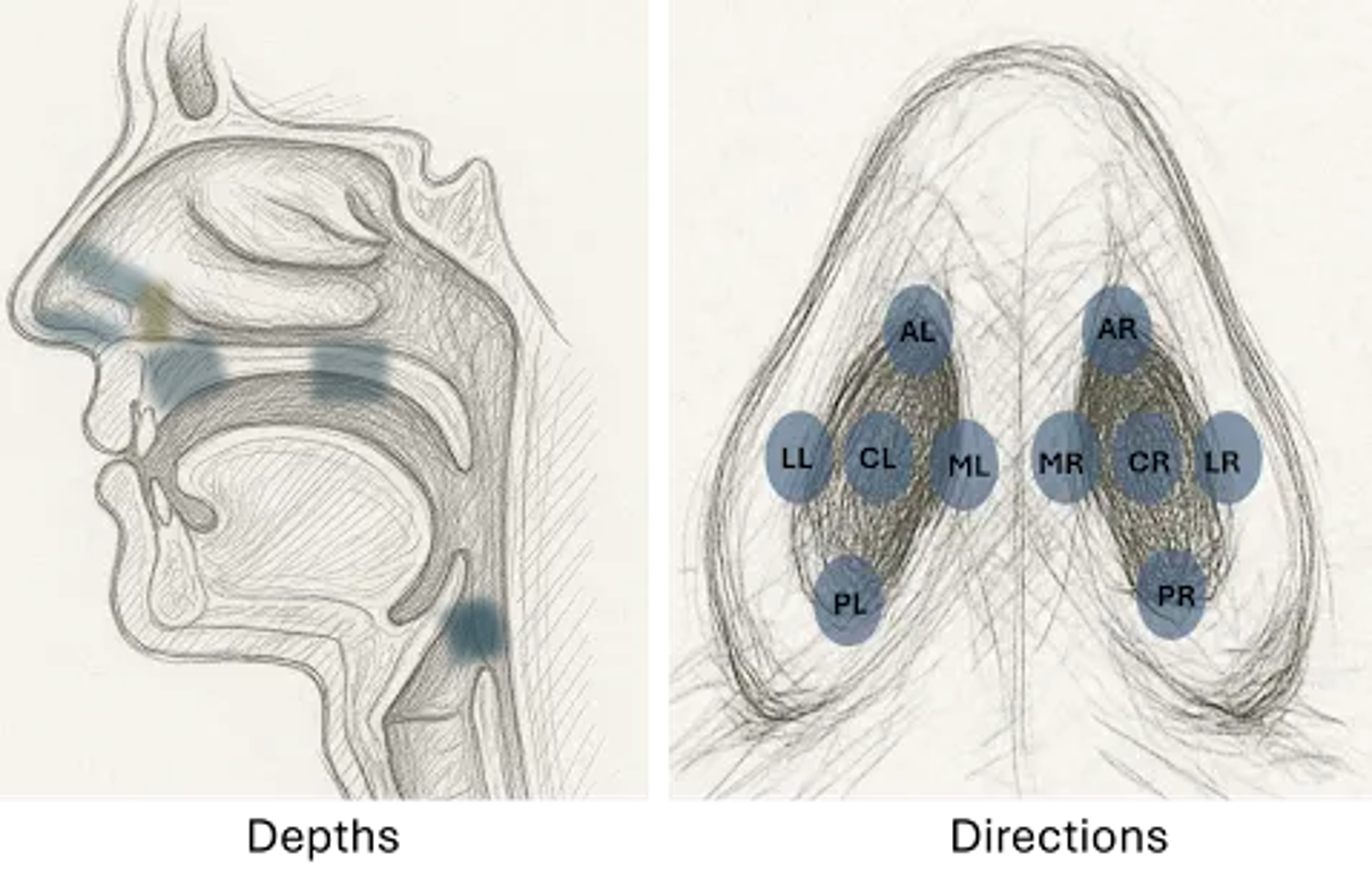
The second note, I propose an exercise designed to help sensitize attention to the tactile sensation of airflow in the upper airways:
A Suggested Exercise to Explore the Location of Air Contact During Inhalation
(But before attempting the suggested exercise, take some time to observe where you feel the touch of the air in your upper airways. Where do you notice a sense of coolness as you inhale?)
Exercise:
“Try the following: fix your eyes on a point in front of you and inhale as if the air were entering through the tip of your nose, focusing your attention on the outer edges of the nostrils closest to the tip. If you find it difficult, gently touch the tip of your nose with your finger while inhaling, and then exhale.
Now, inhale as if the air were entering through the outermost part of the nostrils nearest your face—that is, the region along the outer edge where the nose meets the face. Use the same gentle touch technique if needed, and then exhale again.
Were you able to notice any difference between these two ways of inhaling? Did the airflow seem to enter more through the tip in one case, and closer to the face in the other? If so, how did you perceive this difference?
Finally, try inhaling while starting at the tip of your nose and guiding the air toward the part of the nostrils closest to your face, then exhale.
Were you able to make this transition? How did you notice that you succeeded? What do you feel you did to change from one position to the other?”
You can also try bringing this sensation of the air to other parts of the upper airways, such as the back of the throat, the palate, and other areas. Explore!
**
From Description to Modulation
Phenomenological observations are not limited to describing a phenomenon as it is lived; strictly speaking, their primary aim remains descriptive rather than interventionist.
Nevertheless, in applied and naturalized frameworks that integrate phenomenology with the cognitive sciences, the guided explicitation of experiential micro-dynamics may open a reflective space in which bodily and experiential organizations become accessible to awareness. Under such conditions, it may become possible, in some cases, to indirectly influence and modulate these patterns.
In the study conducted by Claire Petitmengin (2007), explicitation-based microphenomenological interviews helped uncover subtle pre-ictal experiential signs in epileptic patients. Through this refinement of attention, some participants became able to recognize early experiential changes preceding seizures.
This increased awareness opened a temporal window during which they could take precautionary actions — such as interrupting ongoing activities, adopting safer bodily positions, or engaging in attentional and bodily regulatory strategies — and, in some cases, even modulate or delay the onset of the crisis.
A similar logic can be observed in breathing practices such as yogic pranayama, which partly emerged from careful observation of how breathing changes across different affective and cognitive states. The underlying idea is that, by voluntarily reproducing respiratory patterns associated with calmer states, we may facilitate a corresponding reorganization of the bodily system and the "mind.”
Likewise, if we wish to enter another state — more alert, more centered, or more relaxed — the deliberate reproduction of specific respiratory rhythms and qualities can function as a means of experiential guidance. In this sense, phenomenological description is not merely contemplative but also pragmatic: by explicating pre-reflective micro-gestures, subtle regularities between attention, the body, and affective states, it can provide concrete leverage for self-regulation.
**
The Experiential Locus of Inhalation
For me, a particularly favorable locus for inhalation — in the sense of fostering quiet alertness without gradually tipping into nervous activation — seems to be located in the posterior inner portion of the nostril (roughly corresponding to the red area in the figure below), where the cool tactile trace of the incoming air can be most distinctly sensed along the upper airways.
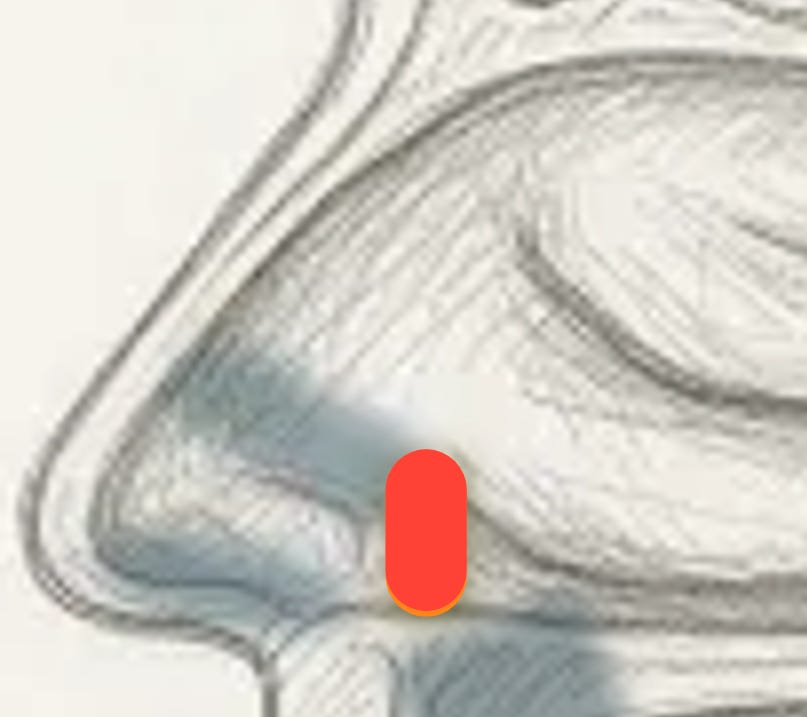
This reorientation of tactile sensing appears to unfold through an internal micro-movement originating in the throat, well below the jaw, in the region of the hyoid bone.
Just give it a try and observe the experience for yourself!
**
References
Petitmengin, C., Navarro, V., & Quyen, M.leV. (2007). Anticipating seizure: pre-reflective experience at the center of neuro-phenomenology. Consciousness and cognition, 16(3), 746–764. https://doi.org/10.1016/j.concog.2007.05.006
Thanks for the reference to the study using neuro-phenomenology and implications for anticipating seizures. Fascinating.